






























What digital signage is, in simple terms
Think of a shop poster, a restaurant menu or a station timetable. Digital signage turns them into screens: instead of printing and replacing paper, you change the content with a click, schedule it by time of day and adapt it to the people walking past.
The word signage refers to all the signs and notices in a place. You will also hear digital signs, digital displays and in-store digital media. Digital signage has four main jobs:
Sell
Promotions, new arrivals and products in shop windows and on shelves.
Inform
Timetables, wayfinding, queues, price lists and notices, always up to date.
Entertain
Immersive experiences with LED walls, anamorphic 3D and interactive content.
Monetise
Selling advertising space on your own screens (retail media, DOOH).
How a digital signage system works
Every system, from a single monitor in a shop window to a national network, is made of the same four elements. The quality of the result depends on how well they work together.
1
The screen
A professional LCD monitor or LED wall, chosen for brightness, format and location.
2
The player
The small computer that plays the content, built in or external.
3
The software
The platform (CMS) used to build playlists and monitor the screens.
4
The content
Videos, graphics and data designed to be read in a few seconds.
Our software
FluidNEXT manages more than 10,000 screens in Italy and abroad
Scheduling, remote monitoring, integrations with business systems and audience measurement with FluidNEXT Counter.
Types of digital signage screens
The choice starts from the location: indoor or outdoor, viewing distance, sunlight, available space. These are the main solutions, all designed and built by Tecnovision in Italy.
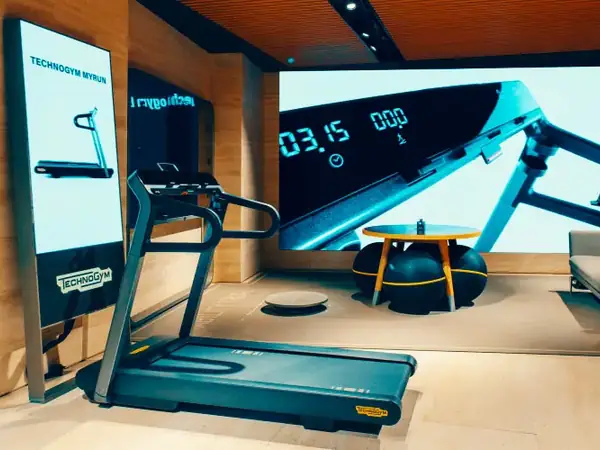
Indoor and outdoor LED walls
Bezel-free LED surfaces of any size, curved too. For facades, stadiums, showrooms and events.
Explore LED walls →
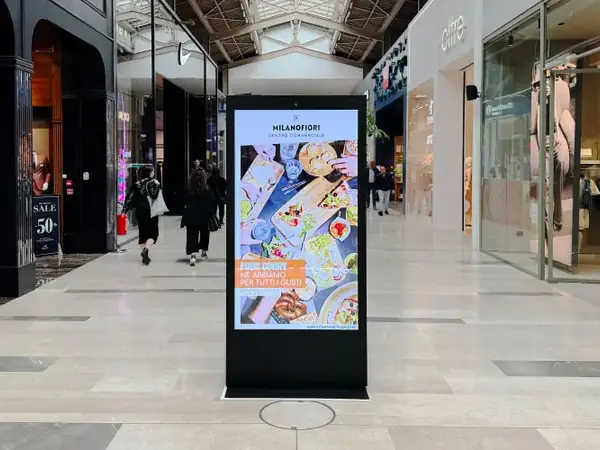
Digital totems
Free-standing screens, single or double-sided, for shop windows, entrances and aisles. Touch and interactive versions too.
Explore totems →
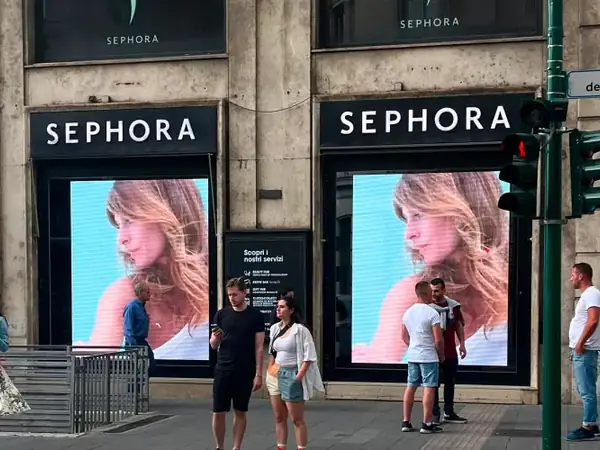
Digital shop windows
High-brightness monitors readable even in direct sunlight, for agencies, shops and banks.
Explore shop window displays →
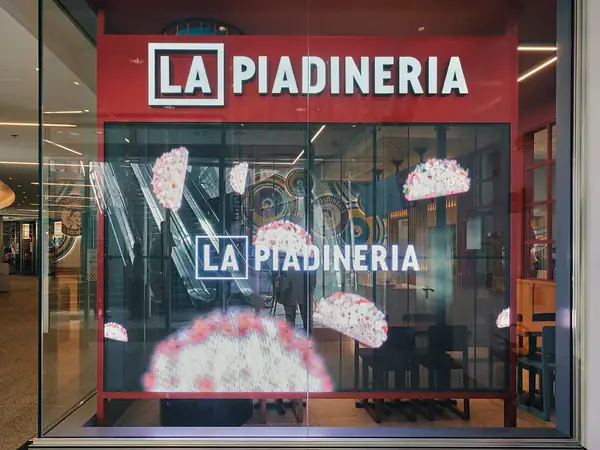
Video walls
Several monitors side by side with ultra-thin bezels, for large images in indoor spaces.
Explore video walls →
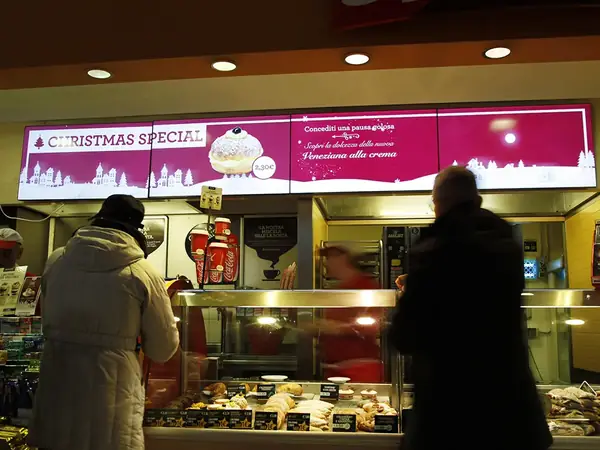
Digital menu boards
Price lists and promotions for restaurants and food retail, updated in real time.
Explore menu boards →
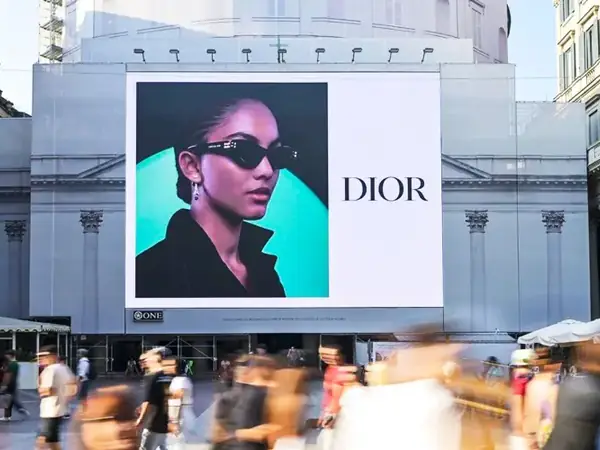
Large-format LED billboards
Large urban LED screens for outdoor advertising and DOOH networks.
Explore LED billboards →
Digital signage, DOOH and traditional billboards: the differences
These terms often overlap. The difference lies in who owns the screens and how the content is sold.
Traditional billboards | Digital signage | DOOH | |
|---|---|---|---|
Content | Static, printed | Video and data, updated remotely | Rotating advertising spots |
Who communicates | The shop or the company | The screen owner, for itself | Advertisers, who buy airtime |
Updates | Reprinting and replacing | Instant, schedulable | Instant, programmatic too |
Measurement | Estimated | Footfall, dwell time and interactions | Certified audience per campaign |
Where digital signage is used: sectors and real examples
Every market has different goals. Here is how some of the brands we work with use it.
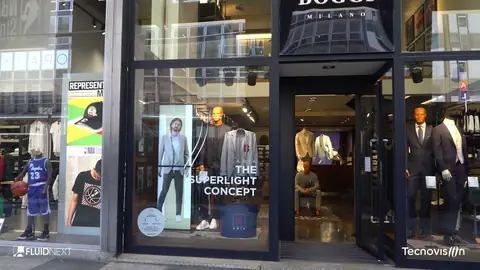
Retail and fashion
Boggi Milano: the mannequin goes digital in 220 stores
Double-screen totems in shop windows, managed from a single point with playlists and content.
View the case study →
Food
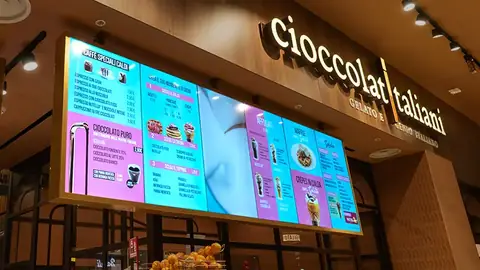
Cioccolatitaliani: menu boards in more than 30 stores
Menu board video walls with prices updated in real time across the whole chain.
View the case study →
Real estate
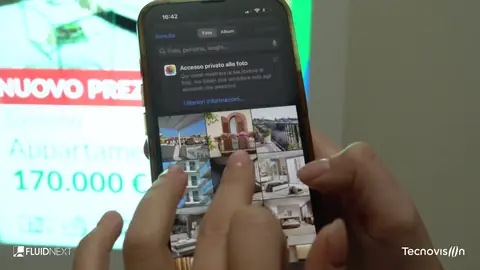
Tempocasa: the agency window that updates itself
Totems integrated with the property management system: listings reach the screen with no manual steps.
View the case study →
Sport
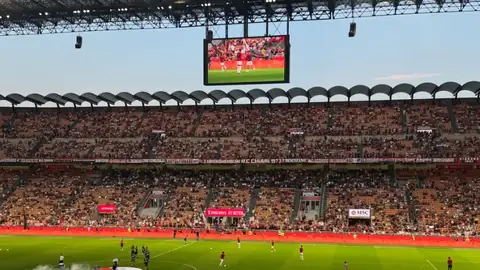
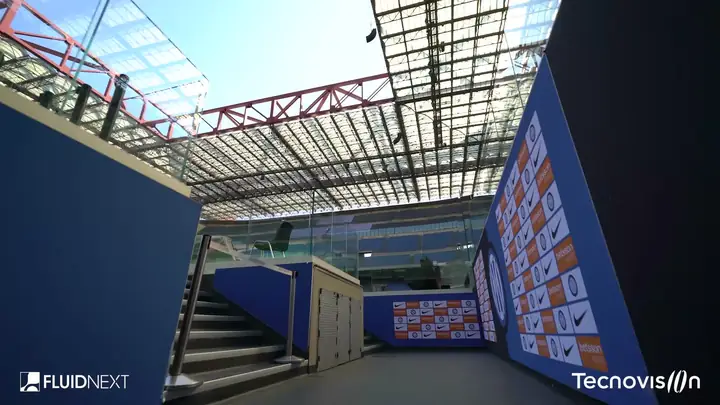
San Siro: the world's first two-tier 4K perimeter LED
For AC Milan and Inter, more than 440 m² of pitchside LED on two levels, with 30 million LEDs, for sponsors and TV audiences around the world.
View the case study →
DOOH
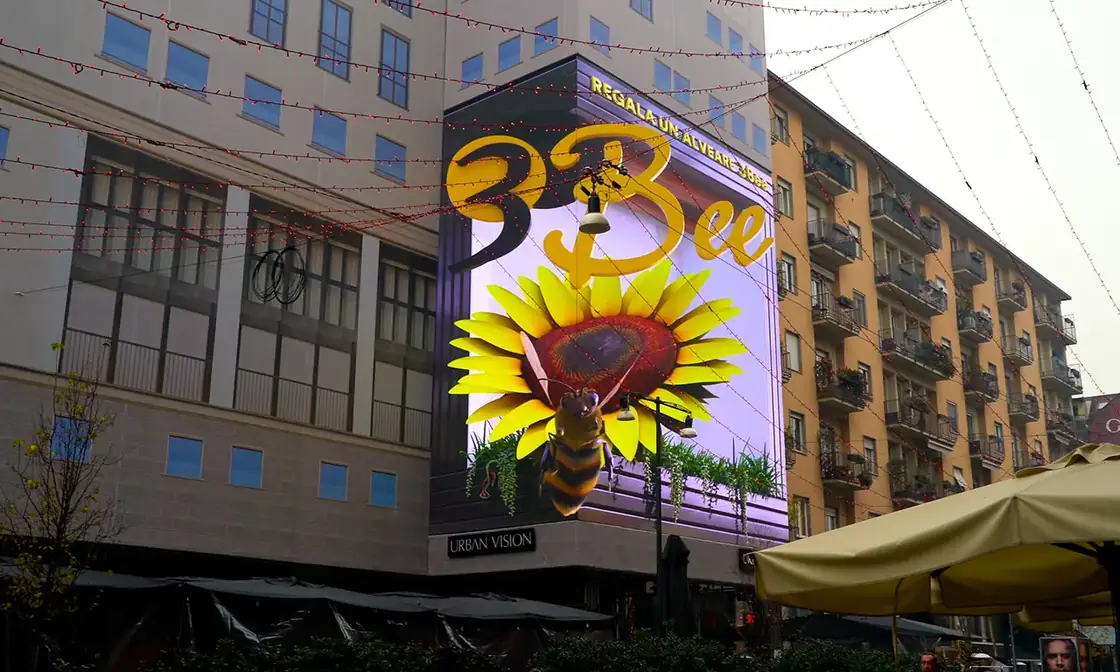
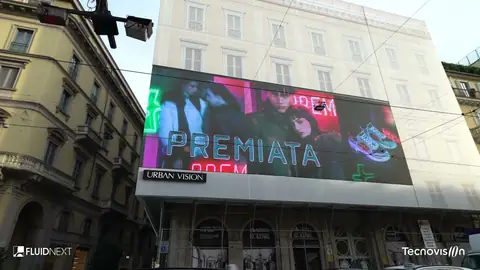
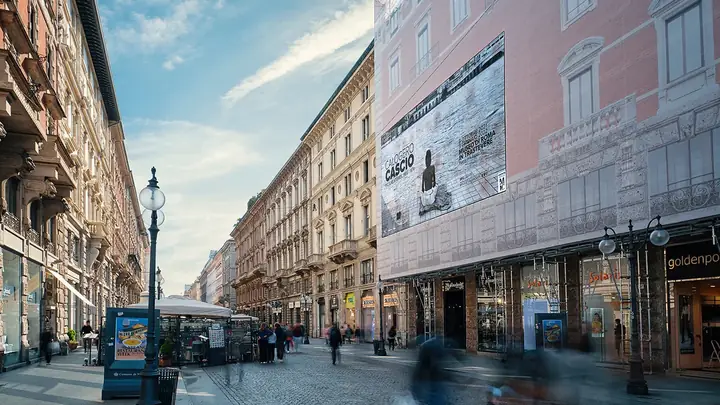
Urban Vision: large-format LED billboards in city centres
Corner and curved LED walls on the most beautiful buildings and monuments in Italian cities.
View the case study →
Art and design
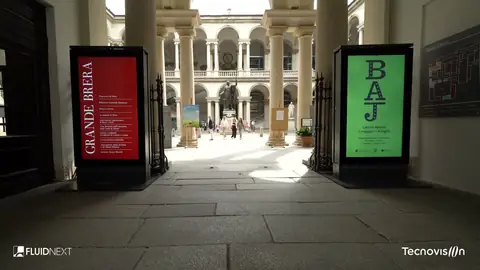
Grande Brera: from the Last Supper to the Palazzo Citterio LED wall
At the entrance to Palazzo Citterio, a Tecnovision COB LED wall of about 20 m² with a 1.5 mm pitch: a window onto the National Museum of Digital Art, opened with the Refik Anadol exhibition. And our technology alongside Leonardo's Last Supper, also part of the Grande Brera.
View the case study →
Why digital signage works: the measured data
Moving content catches the eye more than static content. But the most useful thing is that, unlike paper, a screen can be measured. An example from our network of real estate agencies:
+70%
footfall past the window
220 a day versus 130 estimated with a traditional window.
+150%
dwell time
25 seconds on average versus 10 estimated.
30
QR code interactions
Contacts that a paper window cannot detect.
Source: FluidNEXT Counter data, top-performing agency out of 140 agencies monitored for 3 months.
The history of digital signage in Italy, told by those who were there
Before it was called digital signage, there were LED screens. Tecnovision was one of the first four companies in the world to design and manufacture them in full colour. This is how the market in Italy was born and how it changed, seen from the inside.
1987
Tecnovision is founded, among the first four companies in the world to make colour LED screens
Tecnovision was founded in 1987 and produced its first screen: it was one of the first four companies in the world to design and manufacture full-colour LED screens. Large-screen colour communication was born.
2000s
Up to 5% of the global LED wall market
Tecnovision screens reach 52 countries and the company takes part in all the world's main visual communication events.
2009
The crisis and the arrival of Chinese manufacturers
An Asian supply chain of unmatched strength changes the market. Tecnovision becomes an OEM manufacturer: it keeps design and more than twenty years of know-how in Italy, and produces in high-tech Asian factories.
2013
The relaunch: Tecnovision and All Technology become one
Alessio Abbateianni acquires Tecnovision and merges it with All Technology. From a screen manufacturer, Tecnovision becomes the first company to combine LED walls, digital signage on LCD displays and totem manufacturing, all driven by proprietary software.
2015
Expo, the Darsena and the screen that goes omnichannel
For Expo 2015 Tecnovision builds The Cube with Access (GroupM): a floating LED platform measuring 8 metres per side in Milan's new Darsena. The same year, in-store LED walls become HTML5 browsers with FluidNEXT Retail: content updated in real time from a tablet and interaction with the customer's smartphone. Brands adopting them include Armani, Coin, OVS, Mondadori, Kiko, Sephora and Fineco, backed by a development team of more than 50 professionals in Italy.
2020
San Siro: a world first in football
With AC Milan and Inter, Tecnovision and AIM Sport bring world football's first two-tier 4K perimeter LED system to San Siro: more than 440 m² of surface and 30 million LEDs, designed for 4K broadcasting.
Today
The complete digital signage supply chain
More than 12,500 installations, over 10,000 screens managed with FluidNEXT and an after-sales service based on Tecnovision AI. More and more top brands choose Tecnovision for reliability and quality.
“We took a company that built screens and turned it into the first one able to bring together LED walls, LCD displays, totems and software. That is what major clients ask for today: a single partner, from design to support.”
Alessio Abbateianni, CEO of Tecnovision and FluidNEXT
Digital signage is a relationship: three partnerships that shaped the market
A system can be installed in a few weeks. A digital signage project that really works grows over the years, together with the client. These three relationships show how the Italian market has evolved in three key sectors.
80%
of Serie A football covered
Sport
Infront Italia: Serie A sponsorship goes digital
Since 2015, together with Infront Italia, we have transformed sponsorship management, extending it to cover 80% of Serie A football. A relationship that has grown match after match, stadium after stadium, and made us leaders in the sports sponsorship market.
- A collaboration that began in 2015 with Marco Bogarelli and continues in 2026 on an exclusive basis across all the clubs managed by Infront
- LED systems for sponsor communication in sports venues
- Sponsorship management extended to much of Italian football
- As early as 2020, FluidNEXT Sport managed more than 40 football, basketball, volleyball and rugby clubs, with giant screens, pitchside boards and digital backdrops (source: Engage, February 2021)
- Digital stage sets for arenas such as the Mediolanum Forum and strategic partnerships at San Siro
3,000
installations in the network, one single partner
Grocery retail media
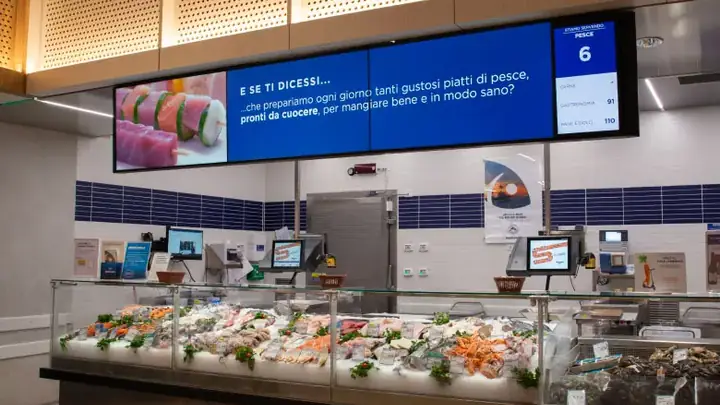
Esselunga: Italy's most advanced grocery retail media network
With Esselunga we have created something unique: a partnership in which Tecnovision brings together, as a single partner, all the roles a retail media network needs.
- Technology provider
- Digital signage platform deployed across about 3,000 installations
- Retail media sales house
- Creative and production support for content
10 years
of collaboration and hundreds of large-format installations
No. 1
large-format LED wall network in Europe
DOOH
Urban Vision: Europe's largest network of large-format LED walls
Urban Vision is the leading sales house for large-format outdoor advertising. In ten years of collaboration we have built together tens of thousands of square metres of screens and hundreds of large-format installations, corner and curved, on the most beautiful buildings and monuments in Italy’s main cities.
- Ten years of continuous collaboration
- Tens of thousands of m² of LED walls installed
- Hundreds of large-format installations, custom-designed for each building
- Tecnovision leads the large-format LED facade market, with a share of about 75%
Why talk to the Italian leader: the entire digital signage supply chain in one company
We are one of very few companies in Europe and worldwide to cover digital signage both horizontally, across every market, and vertically, from design to support.
Retail
DOOH
Transit
Sport
Art and design
LED walls
Italian concept and mechanics
More than 20 years of know-how in building LED screens, with design in Italy and production entrusted to high-tech factories.
Totems
Designed, manufactured and assembled in Italy
Proprietary Tecnovision design, from the first idea to final testing.
Software
FluidNEXT, fully proprietary
Scheduling, monitoring, integrations and audience measurement, all developed in-house.
Operations and after-sales
Professional installation and support with Tecnovision AI
Dedicated installation teams and an after-sales service run with Tecnovision AI technology, to keep screens running without interruption.
How to set up a digital signage project in 6 steps
The method we use with the brands we work with, from the first site survey to measuring results.
1
Define the goal
Selling more, informing, cutting printing costs or selling advertising: each goal leads to different choices.
2
Analyse the location
Light, viewing distance, footfall, space and installation constraints.
3
Choose the screens
LCD or LED, indoor or outdoor, with the right format and brightness for the setting.
4
Plan the content
Short messages readable in a few seconds, playlists by time of day and by location.
5
Organise management
Who updates the content, how screen status is monitored, who steps in if something fails.
6
Measure and improve
Footfall, dwell time and interactions: the data shows which content really works.
What the investment depends on
Number and type of screens, installation site (indoor or outdoor), custom structures, software and content management, ongoing support. That is why every proposal starts from a site survey and clear goals: we can prepare one for your project.
Frequently asked questions about digital signage
What does digital signage mean?
It literally means “digital signs”: using screens to show dynamic content that can be updated remotely, instead of printed signs and posters.
What is the difference between digital signage and DOOH?
Digital signage is a company's communication on its own screens. DOOH (Digital Out Of Home) is digital outdoor advertising: the screens carry campaigns from advertisers who buy the airtime.
Which screens do you need for digital signage?
Professional monitors designed to run many hours a day, with brightness suited to the location. Shop windows and outdoor sites need high-brightness screens or LED walls.
Can you use a regular TV?
You can, but it is not recommended: TVs are not designed for continuous use, are less bright and come with different warranties. A professional screen lasts longer and can be managed remotely.
How is content updated?
From online software such as FluidNEXT: you upload videos and images, build the playlist and send it to one or thousands of screens, including at scheduled times.
Does digital signage really increase sales?
It depends on content and placement, but measured data shows more footfall and longer dwell times in front of screens than with static communication.
How long does a digital signage project take?
It depends on the size of the project: from a few months for a single store or installation to multi-year projects to complete and fully run an entire digital network, whether digital signage or digital out-of-home. At every stage, from design to installation and management, the client has a single point of contact.
Digital signage glossary
CMS
Content Management System: the software used to manage content and playlists.
Player
The device that plays content on the screen.
Playlist (schedule)
The scheduling of content by time, day and location.
Pixel pitch
The distance between the LEDs of a LED wall: the smaller it is, the sharper the image up close.
Nit (cd/m²)
The unit of measurement for screen brightness.
DOOH
Digital Out Of Home: outdoor advertising on digital screens.
Retail media
Selling advertising space on the screens in your own stores.
COB (Chip On Board)
LED technology in which the diodes are mounted directly on the board: sharper images and tougher surfaces, ideal for close viewing.
Anamorphic content
3D videos that, seen from the right spot, seem to jump out of the screen.